Aircraft livery and rebranding

Custom airline branding and special liveries, in a fully digitised colour printing process — designed, approved, produced and installed by one team, in the hangar the aircraft is already standing in.

No paint-shop slot
We come to your aircraft, wherever it is
Inside your check
Scheduled into maintenance you already have
Half the time
Removal takes about 50% of the installation, with no glue residue
In short

A livery in vinyl is a certified modification, not a paint job: it needs approved design data, a production approval behind the vinyl, and an installation documented well enough to go into the aircraft records. We carry all three, so a whole scheme runs as one order instead of four — and because the vinyl travels to the aircraft rather than the aircraft to a booth, the work fits into maintenance that is already scheduled.

What is included

Four things that are usually four contracts

Bought separately, a livery means a design organisation, a production organisation and a hangar — with the logistics and the removal at the end left to you. Each interface is a place where the schedule slips.

Artwork adaptation and engineering

Your artwork is scaled and adapted to the actual type — door cutouts, panel joints, antennas, access panels, the registration layout. The modification is then assessed and approved as design data, including the effect on markings that have to stay legible.

EASA Part 21J — design approval

Vinyl kit production

The scheme is produced as a kit: printed and cut vinyl sections, decals, titles, registrations, flags and blankouts. Materials with high erosion resistance and low colour fading, with white, transparent or kiss & cut printing, MICA effects, edge sealing and anti-erosion tape where a surface needs it.

EASA Part 21G — production approval

On-site installation

Our teams travel to the aircraft — your hangar, your Part 145, or a partner hangar we arrange. Access equipment, scaffolding, surface preparation and the working sequence around other maintenance are part of what we plan.

Your Part 145 or our partner hangar

Removal and redelivery

Vinyl comes off without glue residue and without damaging the paint underneath, in roughly half the time the installation took. At the end of a lease, a campaign or an AOC transition we remove it and hand over the records your redelivery inspection asks for.

Lease return and transition

Painted schemes, stencils and technical markings belong to the same scope but have their own pages: paint and repair and placards and markings.

Vinyl or paint

The comparison, without the marketing

Every aircraft needs a base layer of paint. What goes on top is a choice — and there are areas, such as highly exposed surfaces and the radome, where vinyl is not the answer.

 Paint shopVinyl on site
Where the work happensA facility with a free booth — the aircraft is ferried there and backWherever the aircraft already is
SchedulingA dedicated slot, queued behind other operatorsInside a maintenance event you have already planned
ApplicationA controlled environment, many layers, drying timesFaster, in any hangar, with less waste
Service lifeUsually redone every 7 to 8 yearsSeveral years, depending on the aircraft — two-year warranty under agreed conditions
Changing it backSanded back or stripped to bare metal, then repaintedPeeled off, base paint untouched
Partial changesBlending a repaint into an existing scheme is difficultTitles, tail, blankouts or a registration on their own
Design optionsMetallic finishes are where paint is traditionally strongestAlmost any look, including MICA effects

This compares two methods, not two suppliers — we paint as well, and on some jobs paint is the right answer. One line the table cannot show: since the aircraft never flies to a booth, vinyl also avoids a ferry flight — you can work out that saving for your own type.

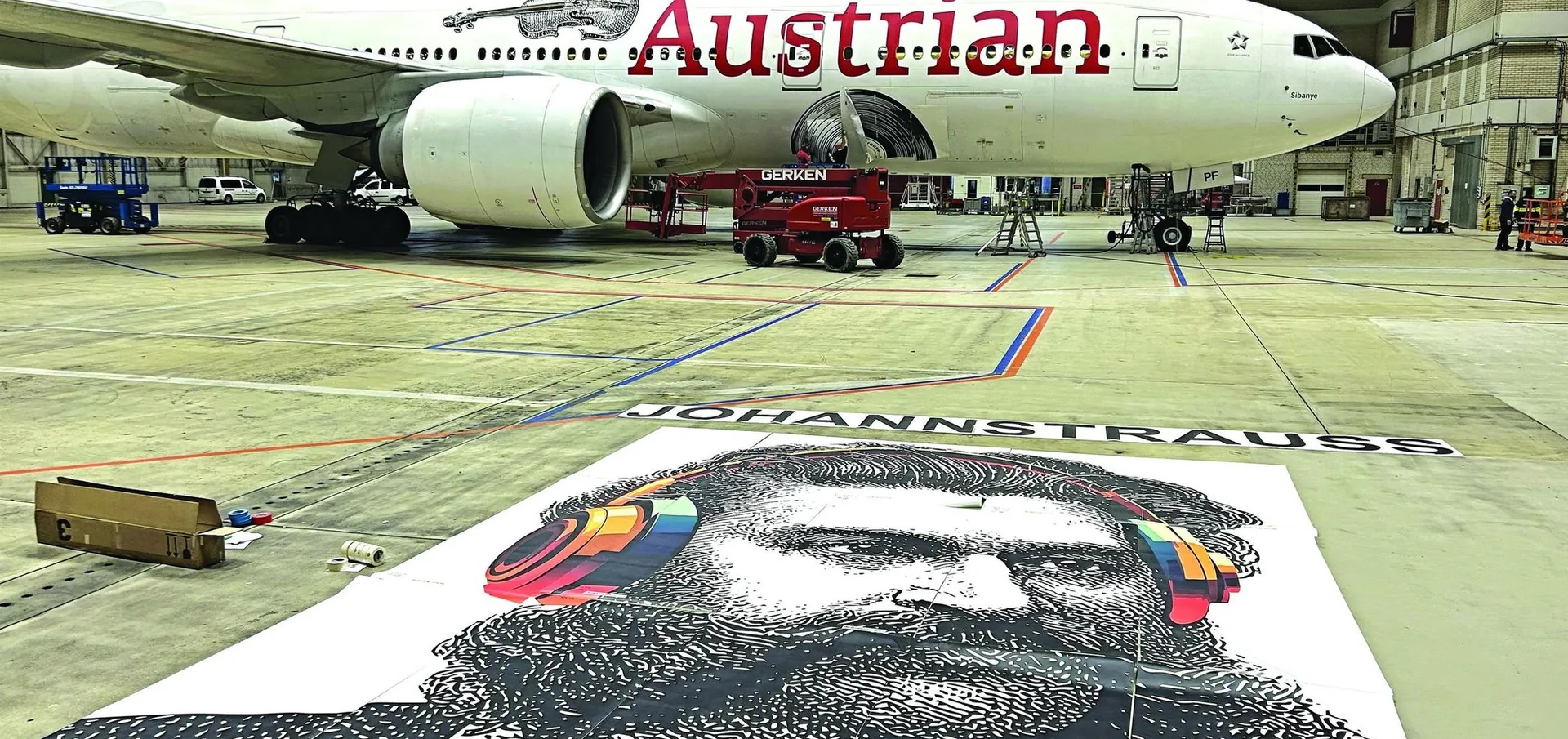
Austrian Airlines Boeing 777 in Hangar 2 with the printed Johann Strauss vinyl laid out on the hangar floor

What we take off your plate

On the Austrian Airlines “Johann Strauss” livery in Hangar 2 in Hannover, the operator provided the aircraft and the location. The printed sections, surface preparation, the precise alignment of the vinyl, access equipment, the working sequence and the coordination with the hangar were ours.

Inside the work

From the print to the aircraft

A livery looks like a single act on the ramp. Most of it happens before the aircraft is touched.

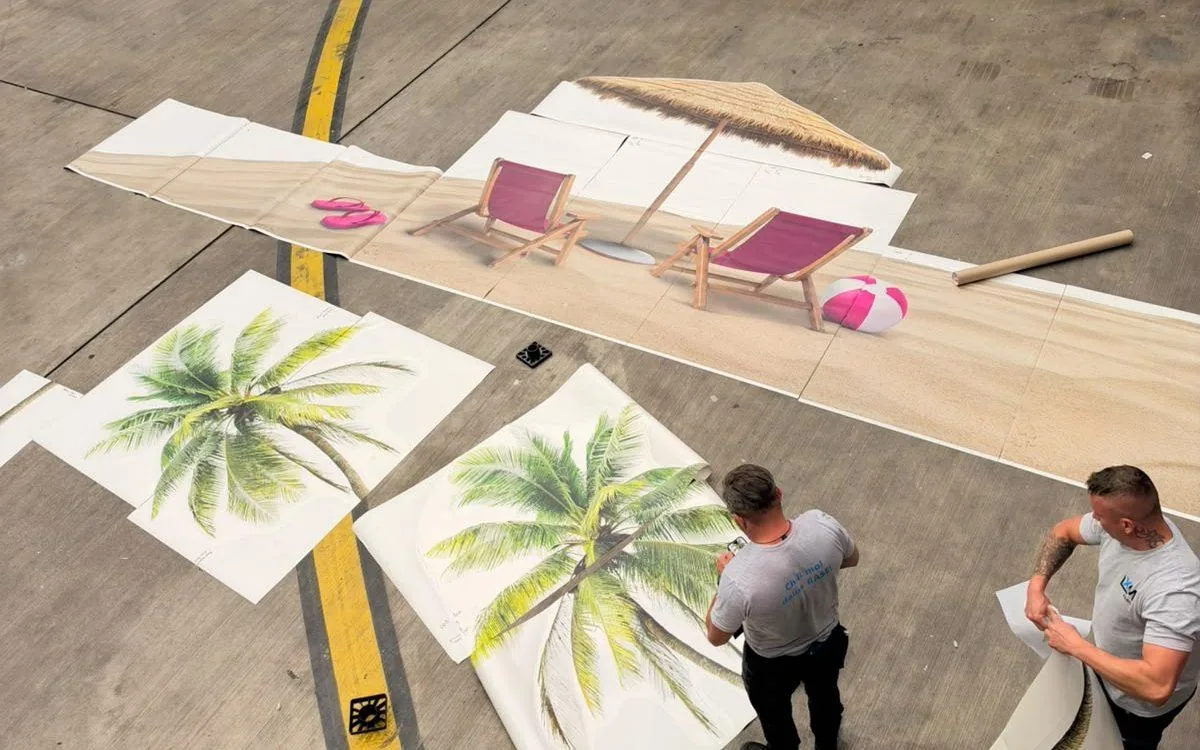
Printed livery vinyl sections laid out on the apron before application
Printed vinyl sections laid out and checked before anything goes on the aircraft.
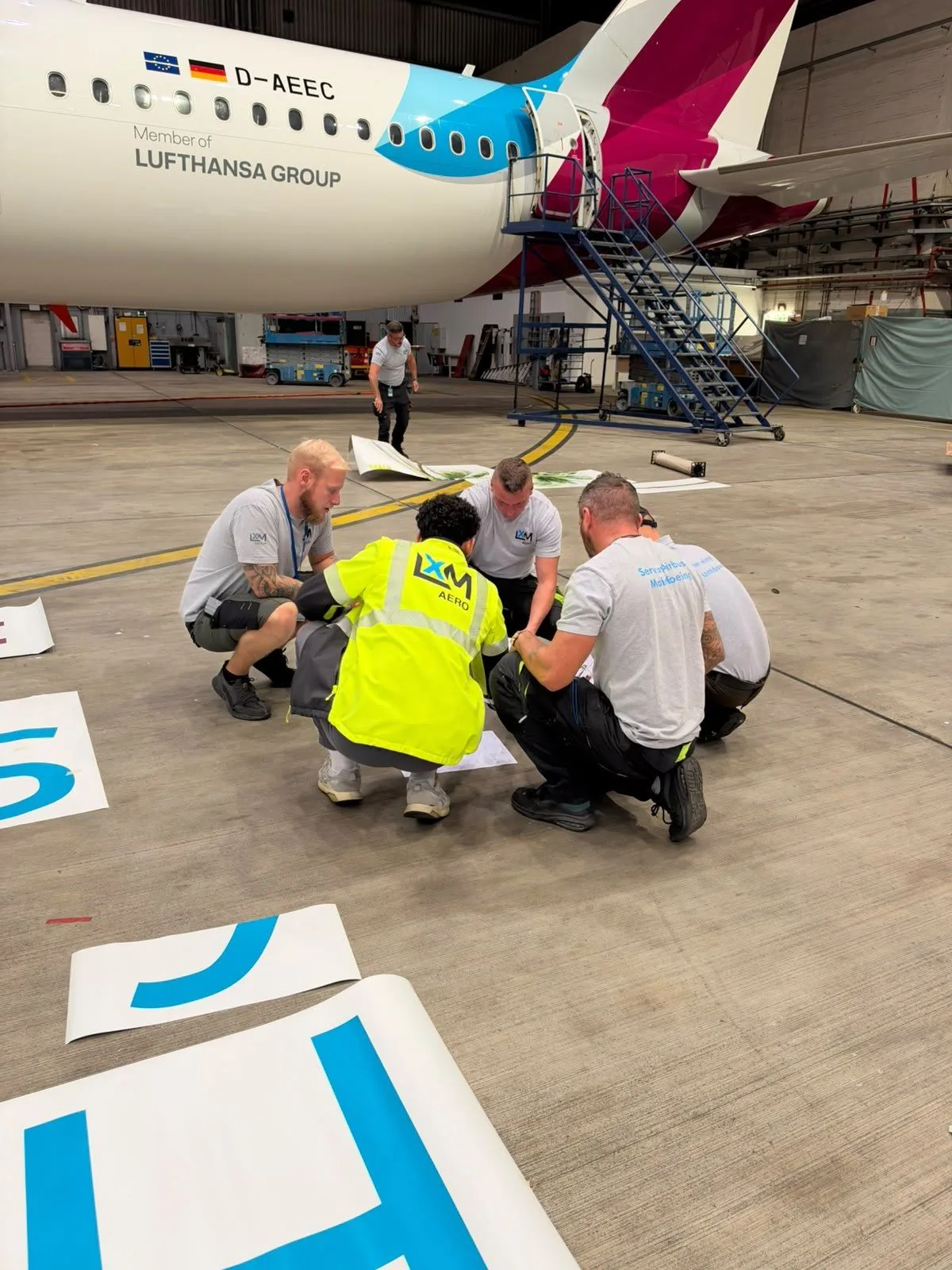
LXM AERO technicians preparing vinyl sections on the hangar floor beside a Eurowings A320
The kit checked against the aircraft before the first section goes on.
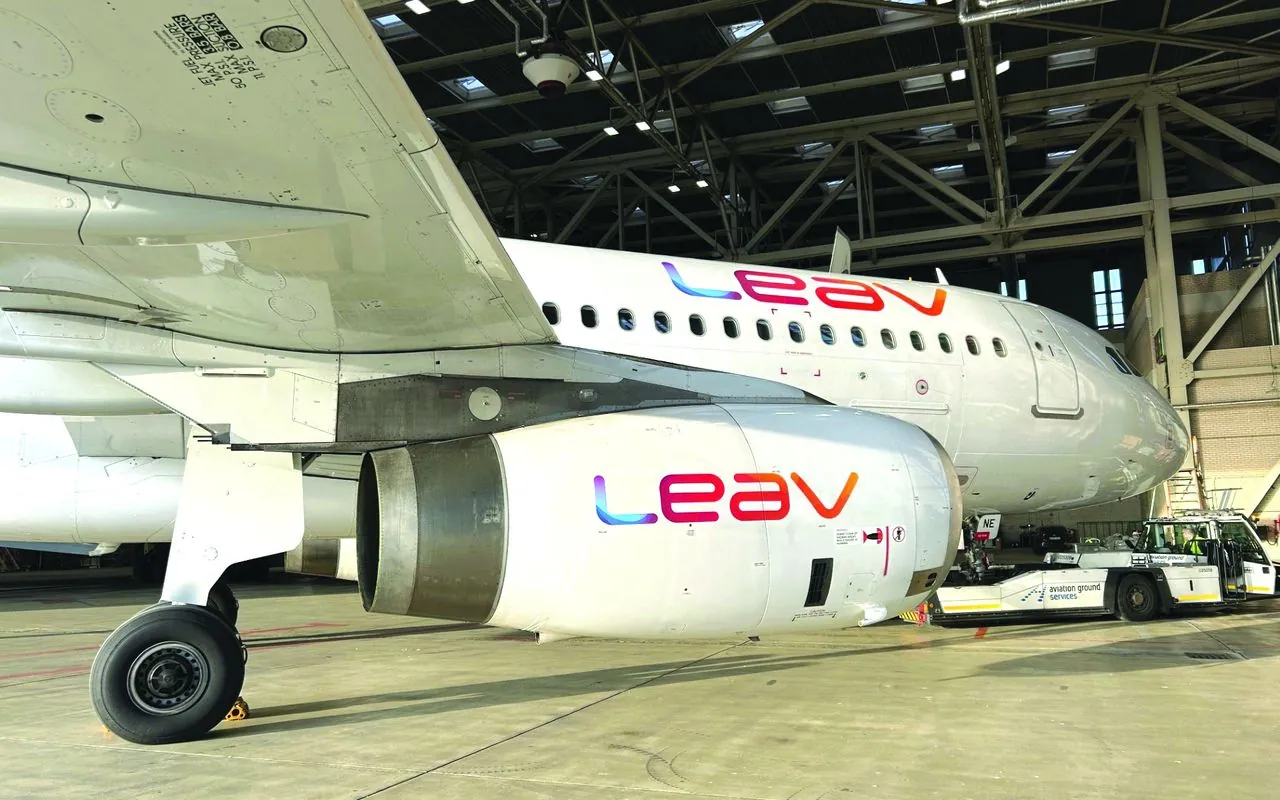
LEAV Aviation Airbus A320 in the hangar carrying its finished livery
The finished scheme on the LEAV A320 — in the hangar the aircraft was already standing in.
Liveries we have delivered Condor · Cyprus Airways · Austrian Airlines · McDonald’s · Eurowings · Transavia · One Air · Air Sénégal See the projects →
Questions we get asked

Livery, answered before the first call

How long does an aircraft livery take?

The installation is the short part — for a narrowbody special scheme, a single night. What sets the date is the run-up: artwork adaptation, the engineering assessment and approval of the modification, and production of the kit. Once the kit exists, further aircraft need no new approval and no new tooling: all fifty Condor aircraft were rebranded inside their planned A-checks, within three months.

Is a vinyl livery as durable as paint?

Vinyl lasts several years depending on the condition of the aircraft, needs little maintenance and carries a two-year warranty under specific conditions*. A damaged section is peeled off and replaced instead of blending a repaint. Paint is usually redone every seven to eight years, with the old scheme sanded back or stripped to bare metal.

* See our terms and conditions.

Does a livery change need approval?

Yes — a livery is a modification and needs approved design data. That runs as an EASA Part 21J Minor Modification through strategic design organisation partners, with the vinyl and decals produced under Part 21G, and the same route is available under UK CAA, UAE GCAA and FAA approvals. You receive the documentation in the form your CAMO can accept into the aircraft records.

Can you work in our hangar, or do we send the aircraft to you?

We come to the aircraft: your own hangar, your Part 145 organisation, a partner hangar we arrange, or — as with Cyprus Airways — the manufacturer’s final assembly line before delivery. If you have no slot of your own, we can provide the hangar: at Hannover, Nuremberg and Bremen you get straightforward access to hangar space and Part 145 infrastructure in a single arrangement, instead of sourcing the building, the approval and the work separately. Work in third-party hangars is fully insured, and we clarify the insurance position before the team travels.

Can only part of the livery be changed?

Yes, and it is one of the more common reasons operators call. Titles, tail design, wingtip logos, flags, registrations and blankouts can each be changed on their own — which is usually what an AOC transition needs.

Can the cabin be done in the same slot?

Yes, and for campaign liveries that is usually the point. On the McDonald’s A320 the exterior, the cabin panels, the tray tables and the ambient lighting were done in the same night. The same applies to cabin work or an IFE installation that was waiting for a hangar visit anyway.

Livery enquiry

Send the scheme and the date.

A rough sketch and a target month are enough for a first answer on feasibility and cost.